Slacks, shoulder pads and suspenders: A deep dive into the iconic costumes of 1980s Bonkbusters – Dr Julie Ripley

Slacks, shoulder pads and suspenders: A deep dive into the iconic costumes of 1980s Bonkbusters

The final lecture in the five-part Bonkbusters series, curated by Jo Parsons.

The lavish mini-series and films based on bestselling fiction by the likes of Jackie Collins, and Shirley Conran explored themes of sex and money in a style that typified the 1980s: glossy, gaudy, and greedy. These Bonkbusters provided audiences with a glimpse into the lifestyles of the rich, famous, and horny, their grand accommodations, opulent leisure pursuits, and perhaps, more than anything else, their taste in clothing – and underclothing.Joan and Jackie Collins: https://x.com/Joancollinsdbe/status/819631064431742976/photo/1

From power dressing in tailored suits to event wear with sparkles and shoulder pads, the clutch bag and stiletto were ubiquitous accessories: these were stories where glamour reigned supreme. Stockings and suspenders, thought to be banished forever by the advent of the mini skirt, returned, along with false eyelashes, long painted nails, and enormous hair.

In a period of accelerating consumer culture, Bonkbusters presented aspirational audiences with icons of success that could be – and were – widely copied. Even today, when you consider purchasing that vintage calf length coat in faux arctic fox, the seductively superior spirit of Joan Collins is included in the price.

In this talk, costume historian Julie Ripley explores the heady mix of synthetic fabric and sharp silhouettes that brought to life badly behaved characters who shopped, ‘bonked’, and entertained a public hungry for excess.

Bio:

Dr Julie Ripley is a course leader for Costume Design for Film & TV at Falmouth University. She has presented widely on dress history, clothing cultures and screen costume. She is interested in costumes where audience pleasures in the genre are not straightforward, such as 1970s slasher movies, contemporary ‘eat the rich’ storylines, or sleazy 1980s erotica.

Copyright free image.

Don’t worry if you miss it – we will send you a recording valid for two weeks the next day

SERIES OVERVIEW

Join us as we enter the glamourous and ruthless world of the Bonkbuster, a phenomenon in mid-late 20th century popular women’s writing, which showed us that sex and excess really does sell, and taught women they could come out on top in both bedroom and boardroom.

‘Jackie Collins hidden behind Wuthering Heights’?: Sex, drama and overstepping boundaries in 1980s teenage girls’ magazines – Dr Joanne Knowles – Zoom

‘Jackie Collins hidden behind Wuthering Heights’?: Sex, drama and overstepping boundaries in 1980s teenage girls’ magazines

The fourth lecture in the five-part Bonkbusters series, curated by Jo Parsons.

In 1983 the teenage magazine Just Seventeen ran a feature on differences between the sexes which declared that girls ‘keep a Jackie Collins book hidden behind Wuthering Heights’. This talk will examine the role of Just Seventeen and other teenage girls’ magazines in acknowledging the increasing level of interest in ‘anything with kissing on the cover’ but also on reading and other media that depicted sexual adventurousness well beyond kissing. The landscape of early-mid 80s is marked by the emergence of sometimes glamorous, always strong women in narratives across media platforms, including bestselling novels by Judith Krantz and Shirley Conran, soaps like Dallas and Dynasty, and the increasing presence of bold women as role models in the pop scene.

Jo will explore 1980s Just Seventeen’s representation of sex, success and women’s roles in an increasingly multi-media world, where prominent women, from Alexis Carrington to Madonna, were held up as daring, morally dubious, yet also inspiring role models. Just Seventeen played a critical role in framing narratives about the tempestuous lives of adult women for a teenage audience, while also maintaining its status as a trusted provider of advice on how actual teenagers should manage their personal lives.

This talk draws on the Femorabilia archive of women’s and girls’ magazines at Liverpool John Moores University.

Biography

Joanne Knowles is a senior lecturer in Media, Culture, Communication at Liverpool John Moores University. She’s written about a range of popular media including Jackie magazine, The Snowman and Auf Wiedersehen, Pet. Jo is a big fan of 1980s pop culture, which allows her to mix business with pleasure.

Image held by Jo’s University’s archives

Don’t worry if you miss it – we will send you a recording valid for two weeks the next day

SERIES OVERVIEW

Join us as we enter the glamourous and ruthless world of the Bonkbuster, a phenomenon in mid-late 20th century popular women’s writing, which showed us that sex and excess really does sell, and taught women they could come out on top in both bedroom and boardroom.

Bitches, studs and hedonistic female pleasures: adapting the bonkbuster in 1970s British cinema – Dr Sian Barber – Zoom

Bitches, studs and hedonistic female pleasures: adapting the bonkbuster in 1970s British cinema

The third lecture in the five-part Bonkbusters series, curated by Jo Parsons.

This talk explores 1970s film adaptations of successful popular fiction ‘bonkbusters’ focusing on the film versions of Jackie Collins’ bonkbusters The Stud (1978) and The Bitch (1979). Starring Jackie’s sister Joan, the film versions were broadly dismissed as trashy, tasteless sexploitation, panned on release for their lack of plot and for the performances. But is there more to be discussed here? These late 1970s adaptations appeared to anticipate 1980s hedonism showcasing money, travel, opulence, decadence and excess. The sexuality being explored is both female and mature. In this fantasy world of money, clothes and opulence, men are either sugar daddy’s or sexual playthings, whilst central protagonist Fontaine Khaled (Joan Collins) emerges as a particular kind of protagonist; hedonistic, determined, self-absorbed and unashamedly sexual. In focusing on the pursuit of sexual pleasure of a mature female character, as well as showcasing her traditionally unattractive female characteristics such as ruthlessness and business acumen, these films are unusual and hint at a progressive agenda in which women set the agenda.

Biography

Sian Barber is a Reader in Film at Queen’s University Belfast. She has published widely on censorship, controversy, and cinema including Censoring the 1970s: The BBFC and the Decade that Taste Forgot (2011) and The British Film Industry in the 1970s: Capital Culture and Creativity (2013).

Joan and Jackie Collins: https://x.com/Joancollinsdbe/status/819631064431742976/photo/1

Image available under free use.

Don’t worry if you miss it – we will send you a recording valid for two weeks the next day

SERIES OVERVIEW

Join us as we enter the glamourous and ruthless world of the Bonkbuster, a phenomenon in mid-late 20th century popular women’s writing, which showed us that sex and excess really does sell, and taught women they could come out on top in both bedroom and boardroom.
Bonktastic Bonkbusters!: Sexing Up Late Twentieth-Century Women’s Writing – Dr Joanne Ella Parsons – Zoom

Bonktastic Bonkbusters!: Sexing Up Late Twentieth-Century Women’s Writing

The second lecture in the five-part Bonkbusters series, curated by Jo Parsons.

The pejorative and spiteful term ‘Bonkbuster’ was derived from ‘bonk’, a British term for sex, and ‘blockbuster’, a very commercially successful book or film, and was used as a means to dismiss a popular, hugely influential, and diverse subgenre of women’s writing which emerged in the 1970s before barging its way, stilettoed and shoulder padded, into the 1980s. The Bonkbuster gave women permission to desire and demand good sex and professional success in a time that was still very much a man’s world. Its authors were revolutionary in many ways; for example, Jackie Collins, ‘Queen of Trash’, celebrity author, and alleged chronicler of Hollywood’s bad behaviour, is famous for her catchphrase and unwavering belief that ‘girls can do anything’; and Shirley Conran was still active until her death in 2024 in empowering women through her social entrepreneurship, a mission which previously involved using her novel Lace (1982) to educate teenagers about sex – an aim that was somewhat undermined by a rather unusual encounter featuring a goldfish.

The Bonkbuster is having something of a resurgence today. The Disney+ adaptation of Jilly Cooper’s Rivals (1988) landed on our screens last year with cheeky pops of champagne corks and a scene featuring an airplane toilet and membership of the mile high club. These women have repeatedly proved that sex sells, while challenging and reshaping attitudes to female sexual pleasure.

This talk will provide a saucy and fun introduction to the Bonkbuster and the ways in which it spiced up both women’s writing and their bedrooms in the late twentieth century.

Biography

Dr Joanne Ella Parsons is Senior Lecturer in English and Creative Writing at Falmouth University. She is an expert on romantic fiction and is currently writing a book on the Bonkbuster. Her books include Doomed Romances (British Library 2024) and 13 Cornish Ghost Stories (Mabecron, 2024)

images available under fair use

Don’t worry if you miss it – we will send you a recording valid for two weeks the next day

SERIES OVERVIEW

Join us as we enter the glamourous and ruthless world of the Bonkbuster, a phenomenon in mid-late 20th century popular women’s writing, which showed us that sex and excess really does sell, and taught women they could come out on top in both bedroom and boardroom.

The Field Guide to DMT Entities – David Jay Brown – Zoom

Mapping the Beings of Hyperspace: A Guided Exploration

Join psychedelic explorer and consciousness researcher David Jay Brown, author of The Illustrated Field Guide to DMT Entities, for a fascinating and interactive journey into the mysterious realms of psychedelic hyperspace. In this unique presentation for London’s Wynd Museum of Curiosities, Fine Art & UnNatural History—a haven for the wondrous, the arcane, and the otherworldly—David will discuss his groundbreaking work in developing a taxonomy of otherworldly intelligences encountered during DMT experiences.

Reports from psychonauts suggest that the DMT dimension is populated by a bewildering array of advanced, autonomous beings—entities that appear intelligent, communicative, and at times even more real than everyday reality. As the boundaries of consciousness expand, so too does the need to map the terrain and catalog the inhabitants of this interdimensional ecosystem.

From the trickster jesters and self-transforming machine elves to the mantis and octopoid healers, reptilian time-lords, and classic Grey aliens, David will introduce you to the most commonly encountered DMT entities, drawing from decades of research, firsthand accounts, and his own experiences. This talk invites participants to consider the profound implications of these encounters—whether they are aspects of the psyche, independent intelligences, or emissaries from parallel realities.

Don’t miss this thought-provoking discussion that blends science

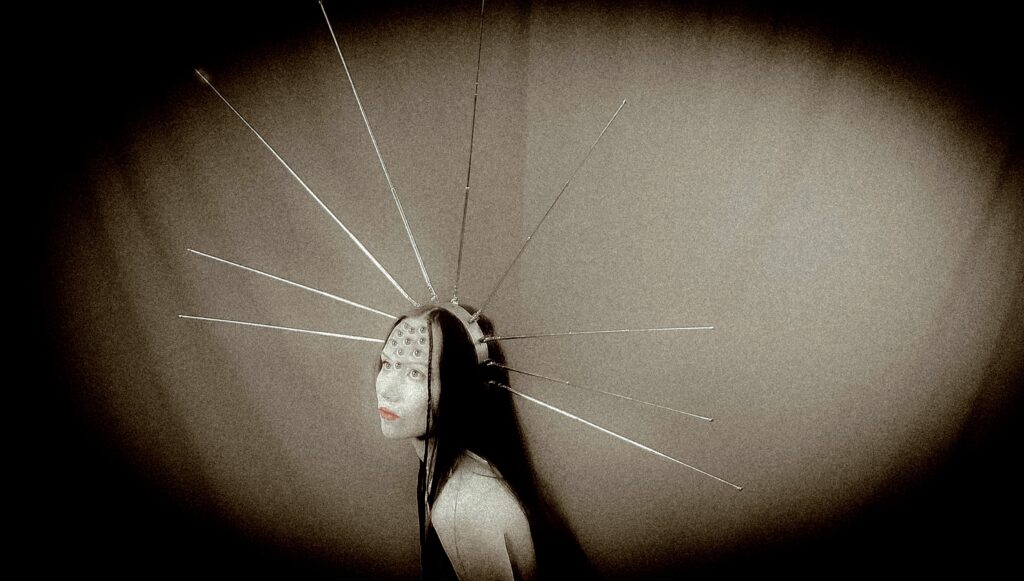
[Image by Sarah Phinn Huntley]

Speaker Bio

David Jay Brown is the author of 19 books on the evolution of consciousness, including Dreaming Wide Awake, The New Science of Psychedelics, and The Illustrated Field Guide to DMT Entities. He holds a master’s degree in psychobiology from New York University and has spent over three decades investigating altered states, transpersonal phenomena, and the frontier science of consciousness.

Speaker Bio

Sara Phinn Huntley is an artist, writer, and researcher who has spent two decades exploring the convergence of psychedelics, technology, and philosophy. As a DMT psychonaut and hyperspace cartographer, she’s pioneering the use of VR technology to investigate visual and spatial imagination in real-time.Her multidisciplinary work documents psychedelic states through an innovative blend of mediums exploring chaos mathematics, geometry, and performance, creating what she calls a “cargo cult effect of higher dimensional artifacts.” Her research has been published by the Multidisciplinary Association of Psychedelic Studies and featured in notable works including Diana Reed Slattery’s “Xenolinguistics”and “The Illustrated Field to the DMT Entities” with David Jay Brown.

Curated and hosted by

Maya Bracknell Watson is an interdisciplinary artist, performer, retired cult leader and psychedelic researcher.

Her background is in psychedelic parapsychology research with Greenwich University, specialising in exceptional human experience and entity encounters on psychedelics, and as an artist. She has studied shamanism for 10 years, working closely with Amerindian indigenous shamanic cultures of Mexico and Peru and western neoshamanic groups, focusing on the introduction and integration of indiginous and animistic knowledge and perspectives to westerners and western ontologies.

She publicly lectures on the subjects of psychedelics and shamanism, and produces art on the subjects informed by her research and experience, including films, performances, writing and immersive worlds. She has performed and exhibited at the Tate Britain and Breaking Convention and is the creator and host of Psychedelicacies, an online lecture series.

Walking between the worlds of art, psychedelic science and shamanism she works to bridge them and uses each as investigatory tools to inform and articulate each other.

Maya
maya

don’t worry if you miss it – we will send you a recording valid for two weeks the next day

Seances and the Female Medium in British Cinema – a Zoom talk with Icy Sedgwick – Zoom

Victorian Spiritualism offered women a tantalising glimpse of freedom through the financial earning power and social status provided to popular mediums. Indeed, while male mediums did exist and regularly toured Britain, it is the figure of the female medium that has characterised how we view these seance leaders in contemporary popular culture. Michelle Yeoh plays one such figure in the latest Poirot film, A Haunting in Venice. This talk will explore how the female medium has been represented in a selection of British films, including The Stone Tape, Quatermass and the Pit, and The Others.


Icy Sedgwick has recently completed a PhD exploring the representation of the haunted house in contemporary Hollywood horror films. She runs the Fabulous Folklore podcast, investigating European folklore and its appearances in popular culture. In case she tires of the research, Icy also writes dark fantasy and Gothic horror fiction.

Your host for this event will be the writer Edward Parnell, author of Ghostland: In Search of a Haunted Country. Ghostland, a work of narrative non-fiction, is a moving exploration of what has haunted our writers and artists – as well as the author’s own haunted past; it was shortlisted for the PEN Ackerley 2020 prize, an award given to a literary autobiography of excellence. Edward’s first novel The Listeners (2014), won the Rethink New Novels Prize. He recently edited Eerie East Anglia: Fearful Tales of Field and Fen (2024) for the British Library’s Tales of the Weird series. For further info see:
https://edwardparnell.com

Don’t worry if you can’t make the talk live on the night – we will send you a recording valid for two weeks the next day

[Photo: a publicity still from the 1964 British crime thriller Seance on a Wet Afternoon]

Arthur Conan Doyle’s Tales of the Supernatural – by James Machin – Zoom

Best known as the creator of the arch-rationalist Sherlock Holmes, Sir Arthur Conan Doyle (1859–1930) also had a deep fascination with the supernatural, which found expression in his eerie, Gothic fiction. This talk delves into the spectral terror, weird horror, and occult intrigue of Doyle’s lesser-known stories in the genre. His fascination with the supernatural shaped his fiction throughout his career, from early tales of Arctic fright and ancient curses to later works exploring spiritualism, psychic phenomena, and the limits of human perception. Beyond the page, Doyle’s unwavering belief in the unseen – particularly spiritualism – became a defining aspect of his public life during his later years, drawing admiration from spiritualist circles but controversy from elsewhere.

Join us for an evening of spectral visitations, haunted minds, and the blurred line between science and faith.


James Machin is an editor, researcher, and writer who lives in Tring. Recent books include British Weird: Selected Short Fiction, 1893–1937 for Handheld Press – and his short fiction has been published in Supernatural Tales, The Shadow Booth, and Weirdbook. His edition of Conan Doyle’s 1895 novel The Stark Munro Letters for Edinburgh University Press was published in 2024 and he has since commenced work in his next volume in the same series, Conan Doyle’s 1908 collection of ‘grotesque’ tales, Round the Fire Stories. More information about the Edinburgh Conan Doyle Project can be found here:
https://edinburgh-conan-doyle.org/

Your host for this event will be the writer Edward Parnell, author of Ghostland: In Search of a Haunted Country. Ghostland, a work of narrative non-fiction, is a moving exploration of what has haunted our writers and artists – as well as the author’s own haunted past; it was shortlisted for the PEN Ackerley 2020 prize, an award given to a literary autobiography of excellence. Edward’s first novel The Listeners (2014), won the Rethink New Novels Prize. He recently edited Eerie East Anglia: Fearful Tales of Field and Fen (2024) for the British Library’s Tales of the Weird series. For further info see:
https://edwardparnell.com


Don’t worry if you can’t make the talk live on the night – we will send you a recording valid for two weeks the next day

The Unsettling Legacy of Edgar Allan Poe’s ‘The Fall of the House of Usher’ – with Antony Clayton – Zoom

Mansion of Gloom: The Unsettling Legacy of Edgar Allan Poe’s ‘The Fall of the House of Usher’

Edgar Allan Poe’s atmospheric tale of madness and premature burial has intrigued and disconcerted readers ever since it first appeared in 1839. In the twentieth century, it attracted interpretations from all fields of artistic creativity: film, television, theatre, opera, music, literature and art.

There have been around twenty film and television adaptations: European filmmakers, from the aesthete Impressionist Jean Epstein in 1928 to schlockmeister Jess Franco in the 1980s, American directors Roger Corman and Curtis Harrington, Czech animation wizard Jan Svankmajer, and British directors such as Ken Russell and Ivan Barnett, whose 1946 adaptation was filmed at a Hastings guesthouse which at the time was the home of notorious occultist Aleister Crowley. Roderick Usher has been played by many eminent actors including Martin Landau, Denholm Elliott, Oliver Reed and, of course, Vincent Price.

The story remains relevant – 2020 saw the release of Lady Usher and in 2023 horror filmmaker Mike Flanagan created the acclaimed eight-episode series The Fall of the House of Usher for Netflix. Musically it has inspired an opera by Philip Glass, an unfinished opera by Debussy and concept albums by The Alan Parsons Project, Peter Hammill and Lou Reed. Steven Berkoff has adapted the story for the stage, Ray Bradbury wrote a science fiction story ‘Usher II’ and numerous artists including Arthur Rackham, Harry Clarke, Alastair and Leonor Fini have produced illustrations.

The House of Usher’s fortunes continue to rise.


About the Speaker

London-born and now living in Hastings, Antony Clayton is the author of Subterranean City: Beneath the Streets of London (2001 & 2010), London’s Coffee Houses (2003), Decadent London (2005, 2019), Secret Tunnels of England, Folklore and Fact (September 2015), Netherwood: Last Resort of Aleister Crowley (2012 & 2017) and Mansion of Gloom: The Unsettling Legacy of Poe’s ‘The Fall of the House of Usher’ (December 2024). He has given talks at the British Library, ICA, Conway Hall, Freemason’s Hall and various other venues in and out of London.

Your curator and host for this event will be the writer Edward Parnell, author of Ghostland: In Search of a Haunted Country. Ghostland (William Collins, 2019), a work of narrative non-fiction, is a moving exploration of what has haunted our writers and artists – as well as the author’s own haunted past; it was shortlisted for the PEN Ackerley 2020 prize, an award given to a literary autobiography of excellence. Edward’s first novel The Listeners (2014), won the Rethink New Novels Prize. His latest book is Eerie East Anglia (pub. Aug 2024) for the British Library’s Tales of the Weird series. For further info see: https://edwardparnell.com

Don’t worry if you can’t make the live event on the night – we will send you a recording valid for two weeks the next day.

[Image: a scene from Roger Corman’s 1960 adaptation of The Fall of the House of Usher.]

Horror and Hilarity: The Théâtre du Grand-Guignol – a Zoom talk with Richard Hand – Zoom

The Théâtre du Grand-Guignol (1897–1962), tucked away in the cobblestoned alleys of Pigalle, Paris, earned a notorious and legendary reputation as the “Theatre of Horror”. Specialising in short plays, it offered audiences an unforgettable blend of gruesome horror and raucous comedy. With its intimate stage and macabre allure, the theatre became a magnet for thrill-seekers, drawing both a loyal local audience and daring tourists. Nestled in a neighbourhood infamous for its brothels and gangs, the Grand-Guignol perfected a unique formula which alternated between realistic slice-of-death dramas and grotesque tales of murder, madness, and depravity. The visceral impact of these performances often led spectators to faint or vomit, requiring the assistance of the theatre’s in-house doctor. Yet, laughter mingled with gasps, as bawdy comedies lightened the tension between the chilling scenes.

While the original Grand-Guignol closed its doors in the 1960s, its influence persists in modern horror across media. Its ingenious blend of terror and humour laid the groundwork for subsequent live horror performances, inspiring immersive experiences and theatrical companies around the world. Academic and theatre director Richard Hand will shed light on the enduring legacy of this remarkable theatre, talking us through the vivid history, shocking artistry, and profound cultural impact of this legendary institution.


Richard J. Hand is Professor of Media Practice and Head of Literature, Drama and Creative Writing at the University of East Anglia. He has a particular interest in historical forms of popular culture, especially horror, and is the author of two books on horror radio drama; the co-author (with Michael Wilson) of four books on Grand-Guignol horror theatre; the co-editor (with Jay McRoy) of two volumes on gothic/horror cinema; and the co-editor (with Mark O’Thomas) of a collection of essays on American Horror Story. As well as an academic, he is a theatre director and award-winning radio writer, including as lead dramatist for the National Edgar Allan Poe Theatre on the Air podcast drama which, in 2020, was archived by the Library of Congress for its ‘historical and cultural significance’.

Your curator and host for this event will be the writer Edward Parnell, author of Ghostland: In Search of a Haunted Country. Ghostland (William Collins, 2019), a work of narrative non-fiction, is a moving exploration of what has haunted our writers and artists – as well as the author’s own haunted past; it was shortlisted for the PEN Ackerley 2020 prize, an award given to a literary autobiography of excellence. Edward’s first novel The Listeners (2014), won the Rethink New Novels Prize. His latest book is Eerie East Anglia (pub. Aug 2024) for the British Library’s Tales of the Weird series. For further info see: https://edwardparnell.com

Don’t worry if you can’t make the live event on the night – we will send you a recording valid for two weeks the next day.


[Image: a montage of various vintage Grand Guignol play posters.]