Dennis McKenna on Psychedelics and evolution: the ā€˜Stoned Ape Theory’

In honour of the 30th anniversary of Dennis and Terrance Mckenna’s ā€˜Stoned Ape Theory’, Dennis McKenna presents an exclusive lecture discussing brand new reflections, theories and findings on the theory based on his ā€˜Stoned Ape Symposium’ taking place in winter 2021.

First proposed in 1992 by 20th century ethnobotanist and psychedelic bard Terence McKenna (1946-2000) in his 1992 book ā€œFood of the Godsā€, and emerging from conversations between the two brothers, the theory proposes that the consumption of psychedelic fungi played a crucial role in the evolution of consciousness and the development of human mind, self reflection, language and culture, and spurring the homo erectus to evolve into the homosapien. He called this the Stoned Ape Hypothesis.

With the re-emergence of psychedelics in mainstream culture and conversations in the psychedelic renaissance, and the elevation of the theory to widespread and popular knowledge, how does it stand 20 years on? What new hypotheses and perspectives have developed from the theory with the increase of psilocybin research? And with the rise of psychedelic research and interest, are we any closer to solving the ā€˜hard problem of consciousness’?

Join us for this fascinating and in depth lecture to find out.

Dennis McKenna Ph.D.

Dennis McKenna, brother of Terence McKenna, is a true psychedelic elder. Among his many engagements and accomplishments, he has conducted research in ethnopharmacology for over 40 years, is a founding board member of the Heffler Research Institute, and was a key investigator on the Hoasca Project, the first biomedical investigation of ayahuasca. Since 2019, he has been working with colleagues to manifest a long-term dream: the McKenna Academy of Natural Philosophy (https://mckenna .academy) dedicated to the study of plant medicines, consciousness , preservation of indigenous knowledge, and a re-visioning of humanity’s relationship with Nature. Dr. McKenna is author or co-author of 6 books and over 50 scientific papers in peerĀ­ reviewed journals. He emigrated to Canada in the spring of 2019 together with his wife Sheila, and now resides in Abbotsford , BC.


This Psychedelic series is Curated by Maya Bracknell Watson and Dr David Luke

Maya Bracknell Watson is an interdisciplinary artist, poet, performer, retired cult leader and psychedelic and parapsychology researcher. Having just graduated from Chelsea College of Arts, her work over the last six years has been informed by her concurrent shamanic training, work with the WixĆ”rika (Huichol) tribe from Mexico, and role as a research assistant under Dr David Luke of Greenwich university in the study of the psychedelic compound N,N-Dimethyltryptamine (DMT) and other worlds. Walking between the worlds of the arts, science and the occult, she combines media and investigative techniques from each to inform and articulate one another in the exploration of ontology, consciousness and altered states, mytholopeia and mythology, ecology, the human condition and its relation to the environment, otherness and mortality. She describes her practise and research as contemporary Memento Mori (ā€˜remember you will die’), and explores what that means in a time of mass ecocide and species extinction.

Follow her on the crooked path on Instagram @maya_themessiah

Dr David Luke is Associate Professor of Psychology at the University of Greenwich, UK, where he has been teaching an undergraduate course on the Psychology of Exceptional Human Experience since 2009, and he is also Honorary Senior Lecturer at the Centre for Psychedelic Research, Imperial College London, and Lecturer on the MSc Consciousness, Spirituality and Transpersonal Psychology for Alef Trust and Liverpool John Moores University. His research focuses on transpersonal experiences, anomalous phenomena and altered states of consciousness, especially via psychedelics, having published more than 100 academic papers in this area, including ten books, most recently Otherworlds: Psychedelics and Exceptional Human Experience (2nd ed., 2019). When he is not running clinical drug trials with LSD, conducting DMT field experiments or observing apparent weather control with Mexican shamans he directs the Ecology, Cosmos and Consciousness salon at the Institute of Ecotechnics, London, and is a cofounder and director of Breaking Convention: International Conference on Psychedelic Consciousness. He has given over 300 invited public lectures and conference presentations; won teaching, research and writing awards; organised numerous festivals, conferences, symposia, seminars, retreats, expeditions, pagan cabarets and pilgrimages; and has studied techniques of consciousness alteration from South America to India, from the perspective of scientists, shamans and Shivaites. He lives life on the edge, of Sussex

This Psychedelic series is Curated by Maya Bracknell Watson and Dr David Luke
Dragons – Professor Ronald Hutton Zoom Lecture

A recording of this lecture will be available to ticket holders for two weeks after the lecture

In the modern Western world, dragons occupy a curious dual space. On the one hand for many people and in many stories, they retain a traditional role as terrifying and predatory monsters which must be slain by heroes. On the other, they are as frequently now represented as friends and allies, faithful steeds or embodiments of benign earth energies. Things get more complex and interesting when it is realised that these two aspects are themselves ancient: in the Old World, western dragons have generally been malevolent, and the dragons of the Far East benevolent. So why is this, and why has the western attitude changed in the modern era? Also, did dragons ever exist, and could they exist, and why did so many humans believe in them if they did not? These are the questions which Ronald Hutton sets out to answer in this talk.

Speaker: Professor Ronald Hutton is a Professor of History at the University of Bristol. He is a leading authority on history of the British Isles in the sixteenth and seventeenth centuries, on ancient and medieval paganism and magic, and on the global context of witchcraft beliefs.

The Botanical Mind: Art, Mysticism & The Cosmic Tree – Gina Buenfeld – Zoom

The magical kingdoms of plants and fungi are too often overlooked, yet the mysteries that reside in their forms and behaviours reveal a significance to human consciousness and spirituality that reaches deep into our evolutionary past, to the beginning of life itself. The symbolic forms of the tree, plant or mushroom appear in global mythologies around the world and in the languages of religious and occult mysticism, from Kabala, Gnosticism, Alchemy and Hermeticism to Tantra, Rosicrucianism and Theosophy. Plants perform a kind of alchemy by transmuting celestial energy from our nearest star into a habitable, terrestrial – material – world and the archetypes of the Cosmic Tree and the Mandala are symbolic motifs that connect the transcendent and terrestrial realms through a world axis – the Axis Mundi. These forms also direct us to the inner realm of the mind, of consciousness, of spirituality – a world that opens-up through the fractal and sacred geometries so resplendent in the vegetal and fungal kingdoms and in encounters with psychoactive plant medicines like ayahuasca, psilocybin and mescalin.

Departing from a recent exhibition at Camden Art Centre – The Botanical Mind: Art, Mysticism and The Cosmic Tree – this talk will explore the ways in which plants have informed artists, mystics and scientists throughout history and around the world. Drawing on the wisdom traditions of indigenous peoples in the Amazon rainforest, where plants reside at the centre of their cosmologies, this talk will speculate on the function of pattern and music as ways to connect and communicate with the life-field we humans are entangled with – a realm that includes microbial, vegetal, and animal life.

Gina Buenfeld-Murley is Exhibitions Curator at Camden Art Centre, London where she has co-curated The Botanical Mind: Art, Mysticism and The Cosmic Tree (2020-21); A Tale of Mother’s Bones: Grace Pailthorpe, Reuben Mednikoff and the Birth of Psychorealism (2019); Athanasios Argianas, Hollowed Water (2020); Wong Ping, Heart Digger (2019); Yuko Mohri, Voluta, (2018); Joachim Koester, In the Face of Overwhelming Forces (2017); JoĆ£o Maria GusmĆ£o & Pedro Paiva, Papagaio (2015); Bonnie Camplin (2016) and Rose English (2016). Recent independent curatorial projects include GƤa: Holistic Science and Wisdom Tradition, at Newlyn Art Gallery and The Exchange, Cornwall, and Origin Story, at The WƤinƶ Aaltonen Museum of Art, Turku, Finland (both 2019). In 2017 she was curatorial resident at Helsinki International Curatorial Programme, Finland and has been researching the place of plants within indigenous cultures in Europe and South America, including in Finnish Lapland (SamĆ­ shamanism) and in the Colombian, Peruvian and Brazilian areas of the Amazon Rainforest where she researched the sacred geometries and music of the Yawanawa, Huni Kuin and Shipibo-Conibo peoples. In 2014-15 she was curator-in-residence with Arts Initiative Tokyo (AIT) and established Tokyo Correspondence, a series of exhibitions, residencies and research visits, facilitating cultural dialogue between artists in the UK and Japan and curated At the Still Point of the Turning World at Shibaura House Tokyo, featuring work by Manon de Boer; Joachim Koester; Simon Martin; Ursula Mayer; Jeremy Millar; Sriwhana Spong; Jesse Wine; and Caroline Achaintre. She was previously Director at Alison Jacques Gallery, London.

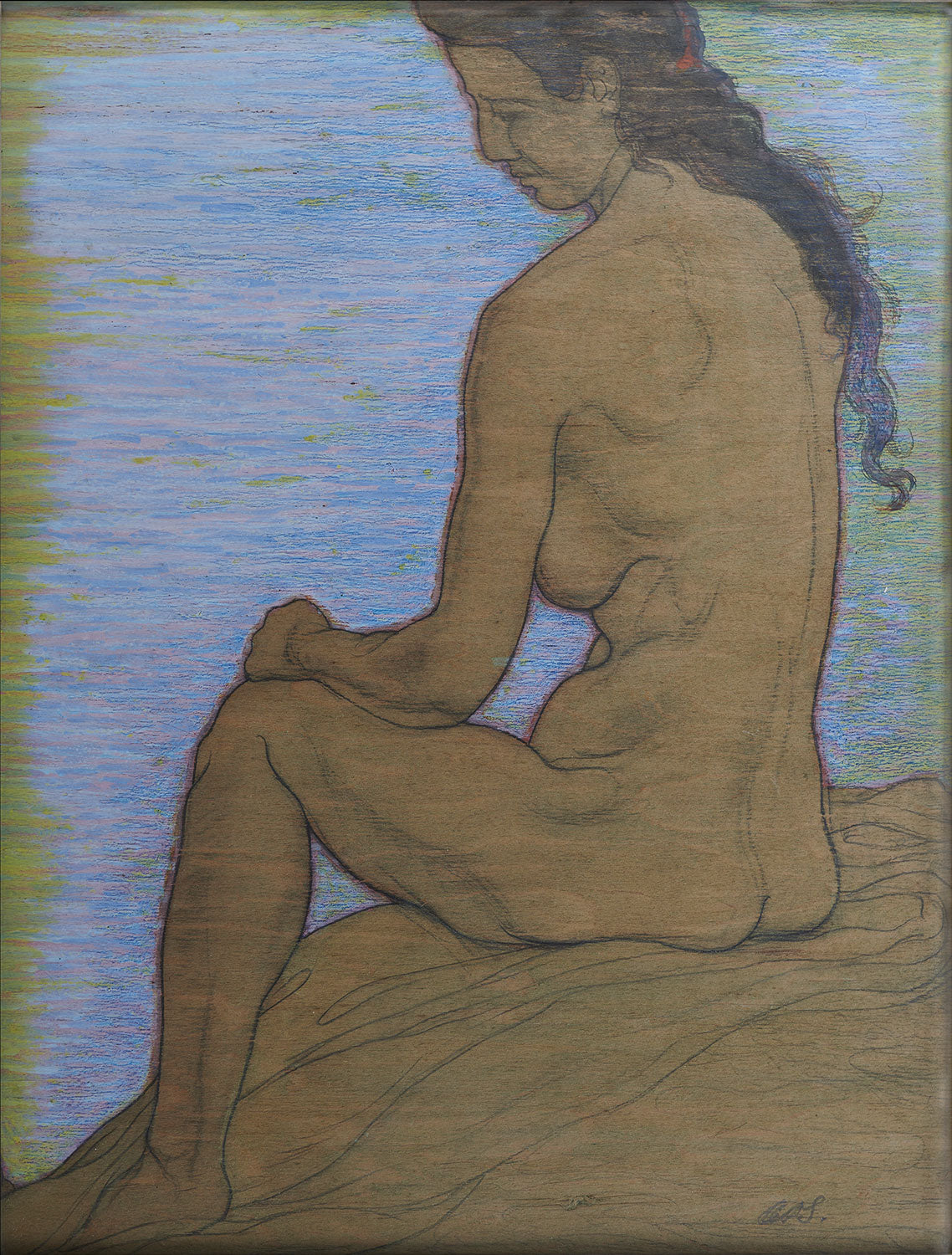
Image Sunset Birth by Ithell Colquhoun

Otherworlds: Psychedelics and Exceptional Human Experiences – Dr. David Luke

This zoom talk is a psychonautic scientific trip to the weirdest outposts of the psychedelic terrain, inhaling anything and everything relevant from psychology, psychiatry, parapsychology, anthropology, neuroscience, ethnobotany, ethnopharmacology, biochemistry, religious studies, cultural history, shamanism and the occult along the way.

This talk is a psychonautic scientific trip to the weirdest outposts of the psychedelic terrain, inhaling anything and everything relevant from psychology, psychiatry, parapsychology, anthropology, neuroscience, ethnobotany, ethnopharmacology, biochemistry, religious studies, cultural history, shamanism and the occult along the way. Staring the strange straight in the third eye this eclectic collection of otherworldly entheogenic research provides a ragtaglledy scientific exploration of syanaesthesia, extra-dimensional percepts, inter-species communication, eco-consciousness, mediumship, possession, entity encounters, near-death and out-of-body experiences, psi, alien abduction experiences and lycanthropy. Essentially, its everything you ever wanted to know about weird psychedelic experiences, but were too afraid to ask…

Dr David Luke is Associate Professor of Psychology at the University of Greenwich, UK, where he has been teaching an undergraduate course on the Psychology of Exceptional Human Experience since 2009, and he is also Honorary Senior Lecturer at the Centre for Psychedelic Research, Imperial College London, and Lecturer on the MSc Consciousness, Spirituality and Transpersonal Psychology for Alef Trust and Liverpool John Moores University. His research focuses on transpersonal experiences, anomalous phenomena and altered states of consciousness, especially via psychedelics, having published more than 100 academic papers in this area, including ten books, most recently Otherworlds: Psychedelics and Exceptional Human Experience (2nd ed., 2019). When he is not running clinical drug trials with LSD, conducting DMT field experiments or observing apparent weather control with Mexican shamans he directs the Ecology, Cosmos and Consciousness salon at the Institute of Ecotechnics, London, and is a cofounder and director of Breaking Convention: International Conference on Psychedelic Consciousness. He has given over 300 invited public lectures and conference presentations; won teaching, research and writing awards; organised numerous festivals, conferences, symposia, seminars, retreats, expeditions, pagan cabarets and pilgrimages; and has studied techniques of consciousness alteration from South America to India, from the perspective of scientists, shamans and Shivaites. He lives life on the edge, of Sussex.

Watch a recording of This Lecture, & 100s of others, for free when you join our Patreon www.patreon.com/theviktorwyndmuseum