Friendship in Doubt: Agnosticism and Magick in Aleister Crowley’s Circle – Richard Kaczynski

Friendship in Doubt: Agnosticism and Magick in Aleister Crowley’s Circle

Infidel. Atheist. Rationalist. Agnostic. Freethinker: Not exactly terms associated with the occult. Yet, at the dawn of the twentieth century, the culture of disbelief briefly united magician Aleister Crowley, soldier J. F. C. Fuller, and poet Victor Neuburg as founders of Thelema, one of the most influential movements in Western esotericism. Rebelling against the restrictive religious and sexual dogmas of their upbringing, these three crusaded against Christianity’s grip on public and civic life. They believed the world, and our conduct, should be governed not by dogma, but by evidence and reason. Under Crowley’s charistmatic leadership, they also came to apply these principles to magic.

This talk uncovers the fingerprints of British secularism upon Thelema: from the “Scientific Illuminism” embraced by the A⸫A⸫, their successor to the fragmented Hermetic Order of the Golden Dawn; their journal The Equinox promoting “The Method of Science, the Aim of Religion”; to Crowley’s famous definition of magick as “the Science and Art of causing Change to occur in conformity with Will.”

Bio

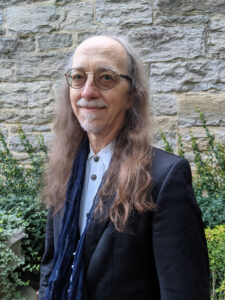
Richard Kaczynski has been a lifelong scholar and international speaker on Western esotericism, with a focus on Aleister Crowley and his milieu. He is the author of Perdurabo: The Life of Aleister Crowley, The Weiser Concise Guide to Aleister Crowley, Forgotten Templars: The Untold Origins of Ordo Templi Orientis; editor of a critical edition of Crowley’s The Sword of Song and co-editor of the collection The Revival of Magick and Other Essays. This talk is based on his latest book, Friendship in Doubt: Aleister Crowley, J. F. C. Fuller Victor B. Neuburg, and British Agnosticism, released earlier this year by Oxford University Press.

Curated & Hosted by

Amy Hale is an Atlanta based writer, curator and critic, ethnographer and folklorist speaking and writing about esoteric history, art, culture, women and Cornwall. She is the author of Ithell Colquhoun: Genius of the Fern Loved Gully (Strange Attractor 2020) and is currently working on several Colquhoun related manuscripts. She is also the editor of Essays on Women in Western Esotericism: Beyond Seeresses and Sea Priestesses (Palgrave 2022). She has contributed gallery texts and essays for a number of institutions including Tate, Camden Arts Centre, Art UK, Arusha Galleries, Heavenly Records and she is a curator and host for the Last Tuesday Society lecture series.

don’t worry if you miss it – we will send you a recording valid for two weeks the next day

Chasing Unicorns: Symbolism in the Unicorn Tapestries – Dr. Juliette Wood

Chasing Unicorns: Symbolism in the Unicorn Tapestries
Unicorns in medieval tapestries are surrounded by flowers, animals, and an array of characters from hunters to gorgeously costumed lords and ladies. These tapestries are among the most precious and striking objects from the Middle Ages. This lecture examines the visual images in the surviving tapestries and the multiple layers of symbolism which give meaning to these beautiful medieval works of art.
Bio

Dr Juliette Wood is a professional folklorist and Celtic scholar educated in the United States, but currently living in Britain. After gaining degrees in medieval philosophy and Arthurian literature, she studied folklore at the University of Pennsylvania, from which she holds both an M.A and a PhD. Her doctoral thesis examined similarities between the geography and cosmology of medieval travelogues and journeys to the other world in Celtic and Italian tales. She continued her studies in folklore and Celtic literature at the University College of Wales, Aberystwyth and at Linacre College, Oxford where she received an M.Litt degree for research into the traditions of the Welsh poet Taliesin.

Dr Wood has also been a professional consultant to TV and media production companies, both UK based and international. In addition she has organised several major conferences such as the Scottish Medievalists Conference in Oxford (1993) and New Perspectives on Fairy lore (1997) in Cardiff. In addition to television and radio work on folklore topics, her major interest at the present time is the relation between medieval tradition and popular culture with special reference to ‘new age’ movements. She currently teaching courses at the Centre for Lifelong Learning at Cardiff University on a range of topis including the ‘Sources of Pagan Thought’; ‘Belief Systems in the Neolithic World’; ‘History of Western Magic’, ‘Arthurian Tradition’ ‘World Mythology’ and ‘Celtic literature and tradition’.

Books

• Eternal Chalice: the Enduring Legend of the Holy Grail (I.B.Tauris, 2008)

The Celts Life Myth and Art (Duncan Baird Publishing London 1998),

The Celtic Book of Living and Dying Duncan Baird Publishing London (2000) (Duncan Baird) .

Introductions to new editions of Charles Squire’s Mythology of the British Isles and P.W.Joyce’s Old Celtic Romances (Wordsworth Editions and the Folklore Society)

The Little Book of Celtic Wisdom (Element 1996)

Legends of Chivalry: Medieval Myth in TimeLife Books Myth and Mankind Series (2000)

Publications include substantial articles in academic journals, such as Folklore, Studia Celtica, and Etudes Celtiques . Her current interests emcompass the narrative traditions in the Middle Ages, especially the folk narrative of Wales.

don’t worry if you miss it – we will send you a recording valid for two weeks the next day

“Beastly Sneak!” Rescuing Other People’s Diaries – Dr Irving Finkel

Beastly Sneak!” Rescuing Other People’s Diaries

This illustrated lecture will consider the fatal doom that usually awaits private diaries of real people once they stop keeping themselves, and why the Great Diary Project has come into existence to safeguard their thoughts and cares for the long-term future. Is this aim pointless and fruitless? No! Why not? Come and see!

For a peak preview of some of the amazing diaries under discussion, check out ‘The Great Diary Project’: Home – The Great Diary Project

Bio

Dr Irving Finkel is serving a life-sentence as curator in the British Museum, where he reads cuneiform tablets of clay from ancient Mesopotamia (modern Iraq). The chance acquisition of a box of orphaned manuscript diaries about twenty years ago led to the founding of the Great Diary Project, driven forward by an excited vision which has proved to be entirely justified. He is the author of the Ark Before NoahThe First Ghosts, and other classics. He has five children and five grandchildren. He believes that writings and books and museums are the greatest of human productions.

Image courtesy of The Great Diary Project ©

don’t worry if you miss it – we will send you a recording valid for two weeks the next day

The History of Snake Women – Dr. Natalie Lawrence

The History of Snake Women

The snake women are some of the most powerful monsters ever imagined. From the snake goddesses of Minoan Crete and the stony-gazed Gorgon Medusa to Echidna, mother of Titans – the combination of women and snakes has long symbolised the awesome powers of Mother Nature. The fecund female form and the regenerative, deadly qualities of snakes has been a natural combination to represent the bloody, messy ability to give life and the threat of death. But the fear of this power, and the excruciating allure of the female, has caused them to be punished for it. Along with women, throughout history.

This talk will explore the monstering of Mother Nature, and how the snake women represent the most primal of fears. It highlights how patriarchal systems have tried to symbolically wrest this power from the feminine: by turning goddesses into monsters that can be slain, in order to absorb the ability to create life and deal death, all the while brutally controlling the force of female sexuality. This meaning is why the snake women are still so potent today, even after thousands of years.

This talk will draw fromEnchanted Creatures: Our Monsters and Their Meanings, Natalie Lawrence’s new book, which delves into the dark histories of the creatures that we have imagined over the past 15,000 years. Monstersembody our anxieties and irrational terrors, giving form to what we don’t wish to know or to understand. Exploring prehistoric cave beasts and serpentine hybrids, deep-sea leviathans and apocalyptic dino-monsters, Lawrence reveals how this monstrous menagerie has shaped our minds, societies and how we see our place in nature.

Bio

Natalie Lawrence is a freelance writer, illustrator and researcher. She has a degree in Natural Sciences and received a PhD in the History and Philosophy of Science from the University of Cambridge for her work on early modern exotic monsters. Her writing has appeared in New Scientist, Aeon Magazine, Atlas Obscura and BBC Wildlife and others, and she has given a TEDX talk and appeared on BBC Woman’s Hour. She lives in London, with her curiosity cabinet and the occasional atlas moth.

don’t worry if you miss it – we will send you a recording valid for two weeks the next day

Urban Legends Ancient & Modern, from Kidnapped Children, Roman Sewer Octopus – Prof. Marguerite Johnson – Zoom

Lecture 5: Urban Legends Ancient & Modern, from Kidnapped Children, Roman Sewer Octopus – 5 Jun 2025

From ancient tales of evil rulers, battlefield apparitions and hauntings, kidnapped children, to madcap stories of octopi in Roman sewers, this talk incudes modern comparisons – from weapons of mass destruction and Saddam Hussein’s human-shredder – to the black swine of Hampstead sewers. It considers the social and cultural power of such urban legends, how these stories enforce rules about the best way to behave, as well as their role in imbuing prejudices around those deemed to be a threat to society.

Interested in some background reading? Some books on old and new tall tales (and urban legends), include: Scott Wood’s London Urban Legends: The Corpse on the Tube and Other Stories; Jan Harold Brunvand’s Too good to be true: the colossal book of urban legends; Adrienne Mayor’s Flying Snakes and Griffin Claws and Other Classical Myths, Historical Oddities, and Scientific Curiosities

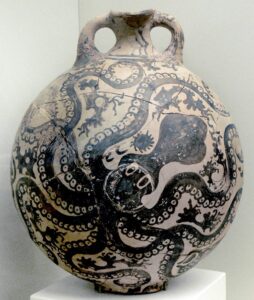
Image: Octopus vase from Palaikastro, c. 1500 BCE. Archaeological Museum of Heraklion.

Bio:

Marguerite Johnson is a cultural historian of the ancient Mediterranean, specialising in sexuality and gender, particularly in the poetry of Sappho, Catullus, and Ovid, as well as magical traditions in Greece, Rome, and the Near East. She also researches Classical Reception Studies, with a regular focus on Australia. In addition to ancient world studies, Marguerite is interested in sexual histories in modernity as well as magic in the west more broadly, especially the practices and art of Australian witch, Rosaleen Norton. She is Honorary Professor of Classics and Ancient History at The University of Queensland, and a Fellow of the Australian Academy of the Humanities.

don’t worry if you miss it – we will send you a recording valid for two weeks the next day


This Lecture is Part of the Folk Horrors In The Classical World a 5 part lecture series – tickets may be booked for this lecture here or for the whole series

In this five-part series, Marguerite Johnson takes you on a journey over land, sea, sky, and into the ethereal world of folk belief in the ancient Mediterranean. Complete with illustrations and the words of the ancients themselves, we look at the strange creatures believed to inhabit land and sea, the terrifying demons that threatened to snatch your child, the werewolf and other shapeshifters, the ancient prototype of the fairytale, ‘Beauty and the Beast,’ and some old-fashioned tall tales.

Series image: Sebastian Münster from Olaus Magnus’ Carta marina (Basel c. 1544).

Cupid, Psyche, Beauty & The Beast – Prof. Marguerite Johnson – Zoom

Lecture 4: Cupid, Psyche, Beauty & The Beast – 1 May 2025

Once upon a time there was a princess called Psyche who was so beautiful that she aroused the envy of the goddess, Venus. As the story goes, Venus sent her son, Cupid to shoot Psyche with an arrow so that she would fall in love with the first hideous thing she saw. However, the clumsy youth scratches himself with his own weapon and falls madly in love with the maiden. So begins a tale as old as time and a prototype for many fairytales thereafter. In this talk we consider the tale of Cupid and Psyche and explore how folktale and fairytale influence generations of tellers, looking at the connections between this ancient tale and ‘Beauty and the Beast.’ It also includes fascinating details about beauty in the ancient world and the many examples of the folklore surrounding it, as well as ancient motifs such as wicked stepmothers and stepsisters, deception, making and breaking taboos, marrying monsters, and animal bridegrooms that continue to inform folktales and fairytales to the present day.

Interested in some background reading? Try Terri Windling’s ‘Retelling Beauty & the Beast,’ Myth & Moor (July 11, 2019): Myth & Moor: Retelling Beauty & the Beast (terriwindling.com) and Simon Hughes’ ‘Was it Really East of the Sun and West of the Moon?’ Folklore Thursday (January 20, 2020): Was it Really East of the Sun and West of the Moon? – #FolkloreThursday

You may also like: Stephen Harrison’s ‘Love and the soul: the timeless tale of Cupid and Psyche,’ Antigone: an open forum for classics and Marina Warner’s book, From the Beast to the Blonde: on fairytales and their tellers

Image: August Riedel, ‘Cupid and Psyche’ (1872).

Bio:

Marguerite Johnson is a cultural historian of the ancient Mediterranean, specialising in sexuality and gender, particularly in the poetry of Sappho, Catullus, and Ovid, as well as magical traditions in Greece, Rome, and the Near East. She also researches Classical Reception Studies, with a regular focus on Australia. In addition to ancient world studies, Marguerite is interested in sexual histories in modernity as well as magic in the west more broadly, especially the practices and art of Australian witch, Rosaleen Norton. She is Honorary Professor of Classics and Ancient History at The University of Queensland, and a Fellow of the Australian Academy of the Humanities.

don’t worry if you miss it – we will send you a recording valid for two weeks the next day


This Lecture is Part of the Folk Horrors In The Classical World a 5 part lecture series – tickets may be booked for this lecture here or for the whole series

In this five-part series, Marguerite Johnson takes you on a journey over land, sea, sky, and into the ethereal world of folk belief in the ancient Mediterranean. Complete with illustrations and the words of the ancients themselves, we look at the strange creatures believed to inhabit land and sea, the terrifying demons that threatened to snatch your child, the werewolf and other shapeshifters, the ancient prototype of the fairytale, ‘Beauty and the Beast,’ and some old-fashioned tall tales.

Series image: Sebastian Münster from Olaus Magnus’ Carta marina (Basel c. 1544).

Witches, Werewolves, Flying Women & Shapeshifters – Prof Marguerite Johnson – Zoom

Lecture 3: Witches, Werewolves, Flying Women & Shapeshifters – 3 Apr 2025

Imagine being able to use witchcraft to change form. To the ancient Romans, witches were able to do this, assuming the form of birds to fly about at night to wreak havoc and evil. In this talk, we meet these fearsome witches, along with werewolves, who did not choose to transform but had transformation forced upon them. Fairy tales are also important to our investigation, and we look at stories such as ‘Beauty and the Beast,’ which may be tied to ancient beliefs in werewolves. As shapeshifters are present throughout time and space, we consider some from other cultures, ending with some modern-day monster-hunters who claim to have found evidence of ‘real life’ shapeshifters.

Interested in some background reading? Try Clare Mully’s ‘Women Who Fly,’ History Today 68.6 (June 2018): Women Who Fly | History Today– a book review of Serenity Young’s Women Who Fly– and April Holloway’s ‘Bizarre Discovery of Werewolf-Like Skull in a Chained Box in Bulgaria,’ Ancient Origins (October 30, 2014): Bizarre Discovery of Werewolf-Like Skull in a Chained Box in Bulgaria | Ancient Origins (ancient-origins.net)

You may also like: Tanika Koosmen’s articles: ‘The Origins of the Ancient Werewolf,’ The Conversation (October 29, 2018): The ancient origins of werewolves (theconversation.com); ‘Why Werewolves Eat People: Cannibalism in the Werewolf Narrative,’ Folklore Thursday (January 18, 2018): Why Werewolves Eat People: Cannibalism in the Werewolf Narrative – #FolkloreThursday

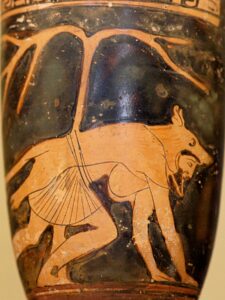
Image: Dolon. Detail from an Attic red-figure lekythos, c. 460 BCE.

Bio:

Marguerite Johnson is a cultural historian of the ancient Mediterranean, specialising in sexuality and gender, particularly in the poetry of Sappho, Catullus, and Ovid, as well as magical traditions in Greece, Rome, and the Near East. She also researches Classical Reception Studies, with a regular focus on Australia. In addition to ancient world studies, Marguerite is interested in sexual histories in modernity as well as magic in the west more broadly, especially the practices and art of Australian witch, Rosaleen Norton. She is Honorary Professor of Classics and Ancient History at The University of Queensland, and a Fellow of the Australian Academy of the Humanities.

don’t worry if you miss it – we will send you a recording valid for two weeks the next day


This Lecture is Part of the Folk Horrors In The Classical World a 5 part lecture series – tickets may be booked for this lecture here or for the whole series

In this five-part series, Marguerite Johnson takes you on a journey over land, sea, sky, and into the ethereal world of folk belief in the ancient Mediterranean. Complete with illustrations and the words of the ancients themselves, we look at the strange creatures believed to inhabit land and sea, the terrifying demons that threatened to snatch your child, the werewolf and other shapeshifters, the ancient prototype of the fairytale, ‘Beauty and the Beast,’ and some old-fashioned tall tales.

Series image: Sebastian Münster from Olaus Magnus’ Carta marina (Basel c. 1544).

The terrifying Female Demons of Antiquity – Prof Marguerite Johnson – Zoom

Lecture 2: The terrifying Female Demons of Antiquity  – 6 Mar 2025

Throughout antiquity, from the Mediterranean to the Levant, the world was animated by terrifying female demons. We begin with Mesopotamian child-snatching demons, also known to harm mothers, and the magical devices to trap them. From West Asia, we travel to Greece to meet Lamia, and Empousa, demons who could assume the form of beautiful women to seduce men and feed on their bodies. From Greece, we encounter Mormo, a scary monster invoked by mothers and nurses to instil good behaviour in children. Included in our survey are some comparisons to similar figures in other times and places, including ogres and vampires.

Interested in some background reading? Try Marguerite Johnson’s ‘‘I gave birth but did not bring a child to life’: for millennia, women expressed their pain through a belief in demonic, female monsters,’ The Conversation (July 5, 2023): ‘I gave birth but did not bring a child to life’: for millenia, women expressed their pain through a belief in demonic, female monsters (theconversation.com)– a book review of Sarah Clegg’s Woman’s Lore: 4,000 Years of Sirens, Serpents and Succubi.

You may also like: Erle Lichty’s ‘Demons and Population Control,’ Expedition Magazine 13.2 (1971): Expedition Magazine | Demons and Population Control (penn.museum)

Image: A seventeenth-century depiction of Lamia by Edward Topsell.

Bio:

Marguerite Johnson is a cultural historian of the ancient Mediterranean, specialising in sexuality and gender, particularly in the poetry of Sappho, Catullus, and Ovid, as well as magical traditions in Greece, Rome, and the Near East. She also researches Classical Reception Studies, with a regular focus on Australia. In addition to ancient world studies, Marguerite is interested in sexual histories in modernity as well as magic in the west more broadly, especially the practices and art of Australian witch, Rosaleen Norton. She is Honorary Professor of Classics and Ancient History at The University of Queensland, and a Fellow of the Australian Academy of the Humanities.

don’t worry if you miss it – we will send you a recording valid for two weeks the next day


This Lecture is Part of the Folk Horrors In The Classical World a 5 part lecture series – tickets may be booked for this lecture here or for the whole series

In this five-part series, Marguerite Johnson takes you on a journey over land, sea, sky, and into the ethereal world of folk belief in the ancient Mediterranean. Complete with illustrations and the words of the ancients themselves, we look at the strange creatures believed to inhabit land and sea, the terrifying demons that threatened to snatch your child, the werewolf and other shapeshifters, the ancient prototype of the fairytale, ‘Beauty and the Beast,’ and some old-fashioned tall tales.

Series image: Sebastian Münster from Olaus Magnus’ Carta marina (Basel c. 1544).

Dryads, Nymphs & Sea Monsters in Ancient Myths – Prof Marguerite Johnson

Lecture 1: Dryads, Nymphs & Sea Monsters in Ancient Myths  – 6 Feb 2025

The ancient Greeks and Romans believed their world to be inhabited by all sorts of beings, creatures that chose to reveal themselves – or not. These are the entities of land and sea, non-human inhabitants, some of whom are referred to as ‘nature spirits.’ Some are sentient, while others are more akin to forces of nature. In this talk, we look at some examples, ranging from dryads and other assorted nymphs to the ketos (a huge sea-monster), and the folktales associated with them. We’ll also consider comparative creatures from other cultures, such as fairies and mermaids.

Interested in some background reading? Try – on fairies – Ronald Hutton’s ‘The Making of the Early Modern British Fairy Tradition,’ Historical Journal 57.4 (2014): 1157-75: Fairies4_1_.pdf (bris.ac.uk)

You may also like: Crystal Rome and Debby Sneed’s ‘Sirens in Ancient Greece and the Near East,’ Department of Classics, University of Colorado Boulder (June 19, 2017): Sirens in Ancient Greece and the Near East | Department of Classics | University of Colorado Boulder

Image: Dryad. Creative Commons (Pxfuel).

Bio:

Marguerite Johnson is a cultural historian of the ancient Mediterranean, specialising in sexuality and gender, particularly in the poetry of Sappho, Catullus, and Ovid, as well as magical traditions in Greece, Rome, and the Near East. She also researches Classical Reception Studies, with a regular focus on Australia. In addition to ancient world studies, Marguerite is interested in sexual histories in modernity as well as magic in the west more broadly, especially the practices and art of Australian witch, Rosaleen Norton. She is Honorary Professor of Classics and Ancient History at The University of Queensland, and a Fellow of the Australian Academy of the Humanities.

don’t worry if you miss it – we will send you a recording valid for two weeks the next day


This Lecture is Part of the Folk Horrors In The Classical World a 5 part lecture series – tickets may be booked for this lecture here or for the whole series

In this five-part series, Marguerite Johnson takes you on a journey over land, sea, sky, and into the ethereal world of folk belief in the ancient Mediterranean. Complete with illustrations and the words of the ancients themselves, we look at the strange creatures believed to inhabit land and sea, the terrifying demons that threatened to snatch your child, the werewolf and other shapeshifters, the ancient prototype of the fairytale, ‘Beauty and the Beast,’ and some old-fashioned tall tales.

Series image: Sebastian Münster from Olaus Magnus’ Carta marina (Basel c. 1544).


Folk Horrors In The Classical World – Prof. Marguerite Johnson – 5 part Lecture Series

Folk Horrors In The Classical World – Prof. Marguerite Johnson – 5 part Lecture Series

In this five-part series, Marguerite Johnson takes you on a journey over land, sea, sky, and into the ethereal world of folk belief in the ancient Mediterranean. Complete with illustrations and the words of the ancients themselves, we look at the strange creatures believed to inhabit land and sea, the terrifying demons that threatened to snatch your child, the werewolf and other shapeshifters, the ancient prototype of the fairytale, ‘Beauty and the Beast,’ and some old-fashioned tall tales.

Series image: Sebastian Münster from Olaus Magnus’ Carta marina (Basel c. 1544).

Lecture 1: Dryads, Nymphs & Sea Monsters in Ancient Myths – 6 Mar 2025

The ancient Greeks and Romans believed their world to be inhabited by all sorts of beings, creatures that chose to reveal themselves – or not. These are the entities of land and sea, non-human inhabitants, some of whom are referred to as ‘nature spirits.’ Some are sentient, while others are more akin to forces of nature. In this talk, we look at some examples, ranging from dryads and other assorted nymphs to the ketos (a huge sea-monster), and the folktales associated with them. We’ll also consider comparative creatures from other cultures, such as fairies and mermaids.

Interested in some background reading? Try – on fairies – Ronald Hutton’s ‘The Making of the Early Modern British Fairy Tradition,’ Historical Journal 57.4 (2014): 1157-75: Fairies4_1_.pdf (bris.ac.uk)

You may also like: Crystal Rome and Debby Sneed’s ‘Sirens in Ancient Greece and the Near East,’ Department of Classics, University of Colorado Boulder (June 19, 2017): Sirens in Ancient Greece and the Near East | Department of Classics | University of Colorado Boulder

Image: Dryad. Creative Commons (Pxfuel).

Lecture 2: The terrifying Female Demons of Antiquity – 6 Mar 2025

Throughout antiquity, from the Mediterranean to the Levant, the world was animated by terrifying female demons. We begin with Mesopotamian child-snatching demons, also known to harm mothers, and the magical devices to trap them. From West Asia, we travel to Greece to meet Lamia, and Empousa, demons who could assume the form of beautiful women to seduce men and feed on their bodies. From Greece, we encounter Mormo, a scary monster invoked by mothers and nurses to instil good behaviour in children. Included in our survey are some comparisons to similar figures in other times and places, including ogres and vampires.

Interested in some background reading? Try Marguerite Johnson’s ‘‘I gave birth but did not bring a child to life’: for millennia, women expressed their pain through a belief in demonic, female monsters,’ The Conversation (July 5, 2023): ‘I gave birth but did not bring a child to life’: for millenia, women expressed their pain through a belief in demonic, female monsters (theconversation.com)– a book review of Sarah Clegg’s Woman’s Lore: 4,000 Years of Sirens, Serpents and Succubi.

You may also like: Erle Lichty’s ‘Demons and Population Control,’ Expedition Magazine 13.2 (1971): Expedition Magazine | Demons and Population Control (penn.museum)

Image: A seventeenth-century depiction of Lamia by Edward Topsell.
Lecture 3: Witches, Werewolves, Flying Women & Shapeshifters – 3 Apr 2025

Imagine being able to use witchcraft to change form. To the ancient Romans, witches were able to do this, assuming the form of birds to fly about at night to wreak havoc and evil. In this talk, we meet these fearsome witches, along with werewolves, who did not choose to transform but had transformation forced upon them. Fairy tales are also important to our investigation, and we look at stories such as ‘Beauty and the Beast,’ which may be tied to ancient beliefs in werewolves. As shapeshifters are present throughout time and space, we consider some from other cultures, ending with some modern-day monster-hunters who claim to have found evidence of ‘real life’ shapeshifters.

Interested in some background reading? Try Clare Mully’s ‘Women Who Fly,’ History Today 68.6 (June 2018): Women Who Fly | History Today– a book review of Serenity Young’s Women Who Fly– and April Holloway’s ‘Bizarre Discovery of Werewolf-Like Skull in a Chained Box in Bulgaria,’ Ancient Origins (October 30, 2014): Bizarre Discovery of Werewolf-Like Skull in a Chained Box in Bulgaria | Ancient Origins (ancient-origins.net)

You may also like: Tanika Koosmen’s articles: ‘The Origins of the Ancient Werewolf,’ The Conversation (October 29, 2018): The ancient origins of werewolves (theconversation.com); ‘Why Werewolves Eat People: Cannibalism in the Werewolf Narrative,’ Folklore Thursday (January 18, 2018): Why Werewolves Eat People: Cannibalism in the Werewolf Narrative – #FolkloreThursday

Image: Dolon. Detail from an Attic red-figure lekythos, c. 460 BCE.

Lecture 4: Cupid, Psyche, Beauty & The Beast – 1 May 2025

Once upon a time there was a princess called Psyche who was so beautiful that she aroused the envy of the goddess, Venus. As the story goes, Venus sent her son, Cupid to shoot Psyche with an arrow so that she would fall in love with the first hideous thing she saw. However, the clumsy youth scratches himself with his own weapon and falls madly in love with the maiden. So begins a tale as old as time and a prototype for many fairytales thereafter. In this talk we consider the tale of Cupid and Psyche and explore how folktale and fairytale influence generations of tellers, looking at the connections between this ancient tale and ‘Beauty and the Beast.’ It also includes fascinating details about beauty in the ancient world and the many examples of the folklore surrounding it, as well as ancient motifs such as wicked stepmothers and stepsisters, deception, making and breaking taboos, marrying monsters, and animal bridegrooms that continue to inform folktales and fairytales to the present day.

Interested in some background reading? Try Terri Windling’s ‘Retelling Beauty & the Beast,’ Myth & Moor (July 11, 2019): Myth & Moor: Retelling Beauty & the Beast (terriwindling.com) and Simon Hughes’ ‘Was it Really East of the Sun and West of the Moon?’ Folklore Thursday (January 20, 2020): Was it Really East of the Sun and West of the Moon? – #FolkloreThursday

You may also like: Stephen Harrison’s ‘Love and the soul: the timeless tale of Cupid and Psyche,’ Antigone: an open forum for classics and Marina Warner’s book, From the Beast to the Blonde: on fairytales and their tellers

Image: August Riedel, ‘Cupid and Psyche’ (1872).
Lecture 5: Urban Legends Ancient & Modern, from Kidnapped Children, Roman Sewer Octopus – 5 Jun 2025

From ancient tales of evil rulers, battlefield apparitions and hauntings, kidnapped children, to madcap stories of octopi in Roman sewers, this talk incudes modern comparisons – from weapons of mass destruction and Saddam Hussein’s human-shredder – to the black swine of Hampstead sewers. It considers the social and cultural power of such urban legends, how these stories enforce rules about the best way to behave, as well as their role in imbuing prejudices around those deemed to be a threat to society.

Interested in some background reading? Some books on old and new tall tales (and urban legends), include: Scott Wood’s London Urban Legends: The Corpse on the Tube and Other Stories; Jan Harold Brunvand’s Too good to be true: the colossal book of urban legends; Adrienne Mayor’s Flying Snakes and Griffin Claws and Other Classical Myths, Historical Oddities, and Scientific Curiosities

Image: Octopus vase from Palaikastro, c. 1500 BCE. Archaeological Museum of Heraklion.

Bio:

Marguerite Johnson is a cultural historian of the ancient Mediterranean, specialising in sexuality and gender, particularly in the poetry of Sappho, Catullus, and Ovid, as well as magical traditions in Greece, Rome, and the Near East. She also researches Classical Reception Studies, with a regular focus on Australia. In addition to ancient world studies, Marguerite is interested in sexual histories in modernity as well as magic in the west more broadly, especially the practices and art of Australian witch, Rosaleen Norton. She is Honorary Professor of Classics and Ancient History at The University of Queensland, and a Fellow of the Australian Academy of the Humanities.

don’t worry if you miss it – we will send you a recording valid for two weeks the next day